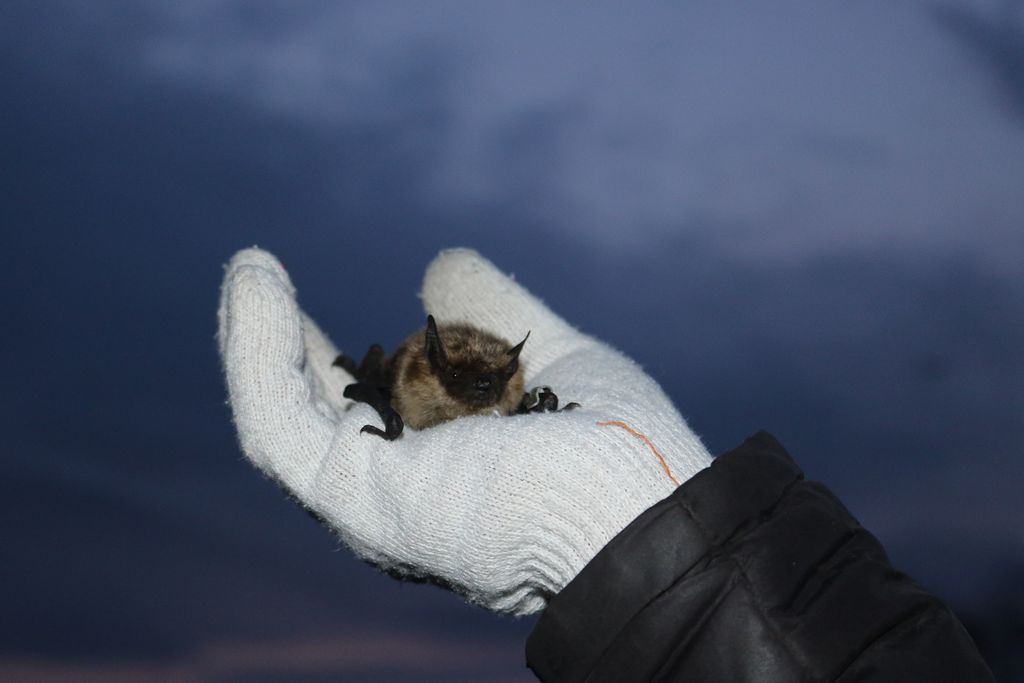
Every winter season at the Ukrainian Centre for the Rehabilitation of Chiroptera concludes with a ceremonial release of rescued bats back into the wild. Each year, we organise public events where we talk about these amazing animals, their significance for nature, the importance of conservation, and our rescue work. We also give everyone the chance to get up close with the bats — you can see the animals at close quarters, find out what their wings look like and even touch them.
The most eagerly awaited moment comes at sunset — the first spring flight of the bats. It’s an incredible experience for everyone — people seeing it for the first time; those who have already attended our events; and our specialists and volunteers who have been feeding and treating the bats all winter.
This year, together with our colleagues, we have rehabilitated and returned around 4,000 animals to the wild. Our aim is to return the bats to the very cities where they were found, so as not to disrupt population structures. This year marks the 15th anniversary of the ceremonial bat releases, which have taken place in 14 cities across Ukraine.
In keeping with tradition, the first city was Kharkiv. On 29 March, at Feldman Ecopark, we released around 500 bats from Kharkiv and the surrounding region.


On the same day, release events took place in Cherkasy, Zaporizhzhia and Rivne. In Cherkasy, our specialist and volunteer Marina organised the event and, together with all those who wished to participate, released 350 animals. On Khortytsia Island (Zaporizhzhia), a closed release took place (for safety reasons), attended by our specialists, volunteers Olesia and Marina, as well as staff from the Khortytsia National Nature Reserve. The Rivne Zoo has hosted a branch of our Centre for many years. There, the zoo’s specialists released 15 bats of four different species back into the wild.


The following weekend, 4 and 5 May, we held release events in Ivano-Frankivsk, Kyiv, Vinnytsia, Lviv, Poltava and Odesa. Each event was a warm occasion and attracted a large number of interested people.
In Ivano-Frankivsk, our co-founder, biologist Alona Prylutska, hosted the event and released 50 bats she and volunteers had rescued, with over 300 people in attendance. Visitors listened to Alona’s lecture on the rescue of bats in cities and had the opportunity to ask the scientist questions. Workshops were organised for children. The event was co-organised by the Dnister Regional Nature Park.


Kyiv surprised us last year with the number of people who turned up, so this time we decided to introduce a registration system for those wishing to attend, for safety reasons. Over 2,000 people came to the event, but only the first 100 to register had the opportunity to release the bats themselves. Nevertheless, we held a wonderful educational talk for visitors, our experts showed the bats up close, we were delighted to meet our volunteers, particularly Galina, and at sunset we released around 250 bats. We are immensely grateful to the Holosiivskyi National Nature Park for the venue and for helping to organise the event.


In Poltava, around 500 animals found throughout the winter in the city and the region were released, as is traditional, in the Arboretum. Visitors were able to watch the feeding, measuring and ringing process, as well as release the bats themselves. Thank you to Ruslana and the other volunteers who rehabilitated the bats in Poltava this winter.


The Lviv ‘Pechera’ bat sanctuary, based at the ‘Home for Rescued Animals’ shelter, welcomed us with around fifty rehabilitated bats. The releases in Lviv are always a grand and heart-warming affair, and this year was no exception.


In Vinnytsia this year, we brought together a large group of people and met our new volunteer, Valeria. It was an informative, large-scale and interesting event. We are grateful to Vinnytsia City Council and our volunteers for their help in organising it.


We were absolutely delighted to visit Odessa this year, as there hadn’t been any major release events there for a long time. Our volunteer Kateryna rehabilitated 27 bats, which we released back into the wild at sunset. We were pleasantly surprised by the number of interested people and their genuine desire to learn more about bats.
10 and 11 April we visited eastern Ukraine — Dnipro, Zelenyi Hai, Kamianske and Kryvyi Rih. In these cities, the events we’ve been organising for many years running are always very warm and intimate.
In Kamianske, we were met by volunteer Oksana and some real bat enthusiasts. The event was cosy, so we talked at length about bats and answered countless questions from the visitors. In Zelenyi Hai, at a private eco-farm, Alona Prylutska gave a lecture on bats to members of civil society organisations and State Emergency Service rescuers, whilst veterans took part in the bat release itself. In Dnipro, we traditionally held the release on Monastyrsky Island, where we released 250 bats and met new people and volunteers. Kryvyi Rih is a special place for the release. Here we gathered a large team of volunteers and friends who always help to make the event wonderful, cosy and unforgettable.


2 April we returned to Kharkiv and held another release ceremony in “Sarzhin Yar”. The bats in need of rehabilitation (around 800 of them) were successfully returned to the wild. Our fellow Kharkiv residents, friends and loved ones created such an incredible atmosphere that we didn’t want to leave for a long time after all the bats had flown away. We are grateful to each and every one of you for your support, interest and attention to such important and unique events.
We are delighted that, despite all the difficulties we faced this winter (shelling, power cuts, lack of food and many others), the bats we rescued have returned to the wild. This reinforces the realisation that our work is important and fruitful.
Thank you to everyone who supports us — through information, financially, physically, and in any other way. Together, we are doing immense and essential work to preserve nature.
And a special thank you to the Ukrainian Defence Forces, thanks to whom we can continue to rescue, study, treat bats and tell the world about it.